Posted on May 28, 2024 at 15:19
In which I renew my S/MIME certificate. Again.
TL;DR: still not a great experience. Some small hopeful signs.
Posted on August 12, 2022 at 11:09

This morning, I was having a conversation with a colleague about the UK federation’s
metadata publication system. We needed to reference the order of operations
and I remembered that I had once published an article about this system, along with a diagram
illustrating just the point under consideration.
Pulling up the article in question, I was slightly surprised to find that the
original article was published exactly ten years ago today.
The original architecture of this system was deliberately flexible, because we didn’t really
know for sure the environment we’d be operating in. It’s gratifying, therefore, to see
that the basic design has held up well enough that we can still use the article as
an informal reference.
In detail, of course, things are different now than we anticipated and the
deployed system has aspects which are simpler than a decade ago, as well as others
which have required some elaboration. At present, for example, eduGAIN has been
successful enough that it is currently the only active source of metadata other than that
registered by the UK federation itself. On the other side, we produce a number of
additional outputs today that we hadn’t really considered at the time, the most important
of those probably being that we now publish per-entity metadata as well as the
aggregate metadata illustrated.
Another major change – one that happened in 2013, about a year after the article
was published – was that we started publishing the tooling itself in a
GitHub repository for the benefit of other organisations working in
the same area. I remember the big challenge there being that the original repository
(which dated back to 2004) contained customer data; the version we published
had to be filtered using git filter-branch for privacy (see the ukf-meta-meta
repository for the gory details). We’ve since rebased our development so that
our internal repository matches the published one except that we don’t expose
development work in progress. I’m really glad not to be reliant on filter-branch
any more, and I’m sure any reader who has dipped a toe into those waters
will sympathise.
Anyway: Happy birthday, helpful diagram!
Posted on June 16, 2022 at 18:10
About three years ago, I said:
I have been signing outgoing electronic mail, on and off, for many years.
It’s getting harder.
The S/MIME certificate I bought back then is about to expire, so I needed to renew.
The trend, let’s say, continues.
Posted on July 5, 2021 at 16:53

As a counterpoint to my previous entry about key signing policies, I thought
it would be amusing to juxtapose a note that, yet again, using PGP/GPG in the real world
has become more difficult.
This time, it’s because one of the most popular ways of acquiring keys for
other people — the sks-keyservers.net pool of key servers — has hung up
its boots.
The site itself says that this was the result of “GDPR takedown requests”;
this appears to mean requests to remove personal information under
Article 17 of the GDPR, commonly known as the “right to be forgotten”.
Of course PGP/GPG public keys usually include the owner’s name and e-mail addresses
as part of the user IDs that are signed to make the web of trust work.
The way the SKS key server software works doesn’t allow removal of
a user’s key: it’s designed to propagate every key known to every node.
Manually removing a key from a node, even if that were possible, would be futile
as it would simply arrive again from another node (or could be uploaded again by
a third party).
If you’re looking for a replacement for the SKS key server pool, one option is
to find a key server that is still in operation, such as “old faithful” at
pgp.mit.edu which is unlikely to be swayed by requests
based on the EU-centric GDPR. Some other servers are based on
the more modern Hockeypuck software, although it’s not clear to me that
it’s any less prone to the same issue that did away with the SKS pool.
For the moment, I’m using pgp.re; we’ll see how it goes.
The other service that’s of interest here is keys.openpgp.org.
This has been gaining popularity for a while as these days it’s configured as the
default key server in a number of packages. It’s probably not going to run into the
GDPR issue by virtue of its requirement that if you upload your key there and
do nothing else, the user IDs on your key are not displayed on privacy grounds.
To make your user IDs visible, you must explicitly request a management link
to be sent to your e-mail address, then follow that and enable visibility for the
e-mail address on that key. You can also delete the e-mail address from the
key if you want.
Unfortunately, by far the majority (upwards of 90%) of the keys in
my public keyring are present in keys.openpgp.org but without any user IDs.
This makes them essentially useless unless you’ve previously exchanged a copy
of the key directly; gpg for example refuses to even import public keys that lack
a user ID:
$ gpg --recv 0xXXXXXXXXXXXXXXXXXXXXXXXXXXXXXXXXXXXXXXXX
gpg: key XXXXXXXXXXXXXXXX: new key but contains no user ID - skipped
gpg: Total number processed: 1
gpg:           w/o user IDs: 1
If you find yourself in this bind, the only option seems to be to somehow figure
out who the owner is (which is hard given that the user ID is missing) and then
get the full public key from them directly (which makes the use of a key server
close to pointless) or get them to go through the management process to expose
their user ID. This can be particularly tricky to explain because, of course,
everything works fine for them as they have a copy of the full key in their
own keyring.
Posted on July 5, 2021 at 16:23
A few months into the current unpleasantness, it became pretty apparent
that I wasn’t going to be doing much travelling any time soon. This made my
PGP/GPG Key Signing Policy 2013-11-07 (which
requires in-person meetings) almost entirely unusable for new signatures.
I still have a need to cross-sign keys with colleages, however, so I have
put together a revised
PGP/GPG Key Signing Policy 2021-02-25.
The new policy takes advantage of PGP’s ability to specify different
signature certification levels depending on the strength of proofing performed
(or on other factors; the specification is not precise with respect to the
meaning of each level).
A level 3 certification (the only one I have used prior to writing the new
policy) is still defined to require in-person physical meeting. I have however
added the possibility of using the lower level 2 certification in the case of
people who are already known to me who for one reason or another I can only meet
on-line. The details are in the policy.
Posted on May 10, 2021 at 16:21
Every HTTP request to this site now includes the following header in the
response:
Permissions-Policy: interest-cohort=()
Read on for the rant explaining why.
Posted on July 29, 2019 at 20:08
I have been signing outgoing electronic mail, on and off, for many years.
It’s getting harder.
Posted on August 28, 2018 at 16:03
Now available for your normative referencing pleasure:
Young, I., Ed., Johansson, L., and S. Cantor, The Entity Category Security
Assertion Markup Language (SAML) Attribute Types, RFC 8409,
DOI 10.17487/RFC8409, August 2018.
See https://www.rfc-editor.org/info/rfc8409.
This has been cooking for quite a long time: the original discussions about the
need for something like this go back to early 2012, and the initial
specification drafts are from later in that year.
Some very early mail I have from Leif credits
RENATER (the operator of the French research and education identity
federation) with the original idea, but as you can see from the Acknowledgements
section it has definitely been one of those “it takes a village” enterprises.
The technical content hasn’t changed very much in the last five years, but it’s
wonderful to have a stable reference available for the many use cases and
specifications we have already built, and continue to build, on top of the
entity category concept.
Posted on July 8, 2018 at 15:35
It has been more than a decade since I wrote
Responsible Behaviour,
in which I mused about how many Wikipedia articles
the man on the Clapham omnibus would need to read to understand
a particular cryptography-related joke. I saw this, in part, as a proxy
for whether cryptography was becoming mainstream. I ended with:
Do you agree? More interestingly, what do you think the answer
will be in ten years?
Posted on June 10, 2018 at 19:00
Posted on April 28, 2018 at 14:41
My podcast application of choice is Overcast by Marco Arment. He has
just released Overcast 4.2, and the announcement is notable for its
enlightened approach to user privacy:
Your personal data isn’t my business — it’s a liability. I want as little as
possible. I don’t even log IP addresses anymore.
If I don’t need your email address, I really don’t want it.
…
And the first time you launch 4.2, people with email-based accounts will
be encouraged to migrate them to anonymous accounts:
Of course it’s not possible for all applications to operate anonymously, but the
principle is important: you should collect only as much personal information as
you require and no more. Anything more than this is a GDPR concern and a
data breach waiting to happen.
Posted on May 29, 2017 at 18:00
Posted on May 22, 2014 at 15:44
The key ceremony for the REEP service took place on 2014-05-18 after the REFEDS
meeting in Dublin,
Ireland.
I witnessed this ceremony and was convinced that the key
attached to this post as a
self-signed X.509 certificate was generated during the ceremony within the
hardware security module in Sweden that will be used by the REEP service to sign
metadata served by it. To certify this, I have generated a
detached signature file
for reep.pem using my PGP key.
To the extent that you trust me to have taken care while witnessing the
ceremony, you may find that validating my signature on reep.pem gives you some
comfort that metadata documents signed by the private key associated with
reep.pem are, indeed, legitimate outputs of the REEP service.
As an aside about the ceremony itself, proof that a particular computational
event has occurred in a particular way is almost impossible in a world of
networking and virtual machines. We’ve known this for a long time: the paranoia
goes back at least as far as Ken Thomson’s
Reflections on Trusting Trust.
We’re not quite living in
The Matrix,
but the evidence of ones senses doesn’t really go very far
towards absolute proof. So what the other witnesses and I did during the
ceremony — all we could do, really — was gain confidence by asking
questions, taking photographs of the steps and trying to think of ways to
validate them. For example, I was later able to verify that the pkcs11-tool
command being used was indeed the one which would be installed on a system
running 64-bit Ubuntu 12.04. Unless, of course, Leif foresaw that trick and
subverted the md5sum command as well. It’s turtles all the way down.
Posted on October 2, 2012 at 03:12
I’m speaking later today as part of a session on the
Future of Federations at the
Internet2 Fall Member Meeting in Philadelphia.
Here is a PDF version of my slides.
They are really just a list of the emerging technologies I think may affect
identity federations in the short to medium term future; I think things are
changing quickly enough that looking further forward than a couple of years is
just too difficult.
Posted on August 12, 2012 at 21:25
One of the systems I work on is the back end of the UK federation’s metadata system. Although I’ve talked about this in several presentations, the bare structural diagram isn’t very informative on its own. Here, I present a snapshot of the architecture, and go into a lot more depth on the what, how and why than you’d get from just the slide on its own (click on the image to get a larger version).
I hope that this article can perform double duty as a case study for the Shibboleth metadata aggregator tool, which acts as the engine behind the metadata system and to which I also contribute as a developer.
Posted on October 11, 2011 at 10:19
I’ve been pretty disappointed by social networking “products” up to this point.
I do use Twitter once in a
while, but it’s pretty ephemeral stuff. I think that’s fine, it means I don’t
have to worry about missing anything.
When I was very young and naïve, I thought Facebook looked pretty interesting.
In practice, the level of sheer malevolence displayed by the company and its
founder have stopped me from using it for anything other than keeping up with
the family.
Ever hopeful, I now have a presence on Google+. It’s possible that this new service will end up as malign as Facebook, but for now at least I feel much less like I am being packaged up and sold as product. It seems, really, like a social network done right.
All that seems to be missing is the people.
Posted on December 2, 2010 at 11:58
I gave a presentation to FAM10 back in October in Cardiff, in the “Not for the faint hearted” session. You can download the slides as a PDF file from the illustration on the right.
My working title was “How to Survive the Coming Zombie Apocalypse”, but the
presentation was really about how to survive the transition from cozy local
federations to federated operation in the global internet. Whether that looks
like a scary prospect depends, of course, on how conservative you’ve been to
date: UK federation recommendations have always emphasised the difference
between technical trust and behavioural trust, and the talk goes into some
detail on this topic.
Understanding trust allows you to protect yourself against the zombie hordes
(sorry, I mean “entities not bound by your local federation’s behavioural
norms”). The other topic covered in detail is how to benefit from
interfederation by making sure that you’re running software capable of
interoperating widely.
Posted on September 29, 2010 at 13:22
BEER is the current attempt at a decent acronym for a new service in the
federated identity space. BEER stands for [Bunch|Bucket|Bag] of End Entities
Registry, and you should be profoundly glad we didn’t go with any of the earlier
names.
You can find out more about it at the project’s wiki; Nicole Harris has a pretty good summary of the idea and what it might mean.
One thing that seems to be confusing people about BEER is that it’s easy to make
the assumption that it’s trying to be a federation along the lines that we have
at present, just with less strict membership rules. I’m not saying that such a
thing wouldn’t have a use (TestShib has been very useful for many people, although it leans so far
towards openness that some would argue that it falls over), but this is not what
BEER is about.
It’s probably more helpful to look at BEER as a new kind of thing, an
independent registrar of metadata. Its job is to assure the authenticity of
the metadata it publishes (in terms of establishing that the metadata for an
entity has a connection to the owner of the associated domain) without
attempting to make guarantees about any of the things you might later layer on
top of that “technical trust”. As such, it’s aiming to be a component in an
overall trust framework rather than a complete solution in the way that many of
the existing federations see their role.
Whether such a service has a long term role to play depends on whether the various existing federations start to converge in terms of their view of their own roles, and of course whether that convergence is in the direction of monolithic trust or in the direction of separation of the different trust components. Both approaches have supporters, of course, and we’ll just have to see how things work out. It will be obvious from previous posts that I’m in the “separate the concerns, behavioural trust is end-to-end” camp, which I’d broadly characterise as the design we chose for the UK federation, and which I think has worked out pretty well in that community.
By coincidence, I’ll be talking at Federated Access Management 2010 (FAM10)
next week about how to survive a scary post-apocalyptic future in which not
all UK federation metadata originates from the federation’s own members, and
BEER will certainly be on the agenda. As will
beer,
of course, although probably not during the talk.
Posted on January 18, 2010 at 12:21
The Thawte Web of Trust, for which I was a fairly junior notary, was shut down recently. This included revoking all existing certificates back in November, at least according to Thawte’s FAQ on the closure. Amusingly — but perhaps not surprisingly to anyone familiar with the area — I’ve had to date precisely no queries relating to my continued use of the supposedly revoked personal e-mail certificate.
The only other S/MIME certificate authority I’m aware of that does Web of Trust type identity validation is CAcert; unfortunately their root certificate isn’t trusted by most browsers and e-mail clients and until that happens (if it ever does) I can’t recommend them as a replacement. Similarly, the lack of built-in PGP/GPG support in current mail clients rules that system out for most people.
If you had a Thawte S/MIME e-mail certificate, you may have been able to trade it in for a 1-year equivalent from VeriSign free of charge. Unfortunately, after the first year it looks like VeriSign charge $19.95 per annum even for a “persona not validated” certificate, which doesn’t sound to me like a lot of bang for your buck.
One alternative for the cost-conscious is Comodo’s Free Secure Email Certificate
product. Again, this is “persona not validated” but should be sufficient for
most uses and you can’t beat the price.
[2019-10-08: Removed link to Comodo’s product, which no longer exists.]
Posted on November 24, 2009 at 08:14
Metadata aggregation as a route to cross-federation inter-operation continues to be my main focus for the year, and yesterday I delivered a presentation on the subject at JISC’s Federating: The Next Generation event.
I think the talk went reasonably well; a couple of people remarked that they
liked having the key concepts separated out and clarified. People even chuckled
in the right places a couple of times.
Checking Twitter for the #FAM09 tag I find that the main thing a couple of people took away from the talk was a snarky remark I made about XSLT. Curiously, I find that I’m fine with that.
As usual, here’s a PDF version of my slides from the presentation:
There are a fair number of animated diagrams in this talk, and not as many words
as usual. That might mean that some parts are hard to follow without hearing me
talk. I’m going to try and get hold of the audio recording made at the time and
will upload a slide-synchronised version of the talk later if possible.
Bonus: 60 Seconds with: Ian Young
Posted on May 22, 2009 at 11:38
I’ve talked about a metadata exchange approach to inter-federation working here before. Since my last update, I think we’ve seen some level of acceptance in both the technical and policy communities that this is — at least in principle — a valid approach, and there is work going on in a variety of places on that basis.
One thing that has become apparent as that work has developed is that we need to look at some of our basic assumptions with a fresh eye: complex problems can be often be simplified by looking at them from a different direction. To that end, Chad La Joie (of SWITCH and Shibboleth) and I have put together Interfederation and Metadata Exchange: Concepts and Methods, the current version of which you can download here:
The main aim of Concepts is to provide a framework in which it is possible to
think clearly about identity federations in a multi-federation world. This
involves first separating concerns and then recombining them in new ways,
leading to what we think is probably best thought of as a global metadata
layer. There is also coverage of some of the technical implications of such an
approach, but we’ve tried to keep that part as light-weight as possible here.
During the recent Internet2 Member Meeting in Arlington, this
document was also reviewed by Scott Cantor, Steven Carmody, Josh Howlett,
Leif Johansson, Thomas Lenggenhager and Valter Nordh. We are grateful
to our colleagues for their many constructive comments, which we have
have tried to incorporate faithfully in the current version. I will
leave it to those individuals to state whether, and to what degree,
they endorse our conclusions.
Posted on April 29, 2009 at 15:43
I’m in Arlington, Virginia this week for the Internet2 Member Meeting.
As usual, lots of good hallway conversations and meetings. I had to
work my passage this time by contributing a presentation to a joint
session on Building on Success: from Identity Federation to Interfederation.
As well as the traditional statistics about how large the UK federation has become, I talked a bit about some of the things I think contributed to its success. This was more in terms of broad concepts than details, the idea being to give people thinking of setting up new federations a guide to some of the tradeoffs involved.
As usual, here’s a PDF version of my slides from the presentation:
Posted on April 12, 2009 at 14:08
Earlier this month, I led a couple of breakout sessions at the UK Serials Group’s conference in Torquay.
I knew that I’d have a wide range of people in the room in each session, so I
put together a slide deck that would have something for everyone and talked
about different subjects to different levels on each of the two days.
Some of the slides won’t make much sense without explanation, but others do
stand alone, I think. If you’re interested, here’s a PDF version of the slides
stripped of the animations:
Posted on October 15, 2008 at 18:33
Alistair at UHI comments on my most recent Metadata Interchange document revision. His post highlights a couple of places where I can see I need to clarify what I’m proposing in a future revision. I recently purchased a copy of the OmniGraffle diagramming tool, and Alistair’s post is a good example of why… sometimes a simple diagram really can be clearer than large amounts of plain text. Misunderstandings aside, I think we agree on most things.
One area where I’ve felt for some time we all need to express things more
clearly is with regard to that thing we call “trust”. I usually break this down
first into “technical” trust (which allows you to know you’re talking to the
entity you think you are) and “behavioural” trust (which gives you expectations
about the behaviour of a known entity). This isn’t the whole story by all
means, but does allow us to see that trust isn’t a singular property; it’s more
like a stack or chain of elements that we can build up into something we can
actually use.
Any federation can choose to act as a trust broker at many levels; for example,
one federation may have strictly enforceable rules controlling member behaviour
while another may leave behavioural trust to bilateral arrangements between
members (such as the commercial contracts that are usually present in content
licensing situations). The UK federation is towards the latter end of the
scale: as all federations do, it acts as a broker of technical trust, but mere
presence of an entity within the UK federation’s metadata has never carried any
behavioural guarantees.
What this means is that if you’re used to operating in something like the UK
federation, your stance is already to treat everyone as a potential ray-gun-toting Martian unless you have some specific reason to view
them otherwise. Adding more Martians from other federations therefore doesn’t
change anything; the important thing that an inter-federation agreement adds is
the assurance that the originating federation has registration procedures strong
enough to prevent a Martian from masquerading as someone you have a real
relationship with, and conversely provides technical trust strong enough to
support you in picking the entities you do want to do business with out of the
sea of entities you don’t care about.
Posted on October 12, 2008 at 22:55
Many thanks to everyone who commented on the previous edition of Some Notes on Metadata Interchange. I’m in New Orleans for the
Internet2 Fall Member Meeting this week, and as I expect to be discussing this area with a number of the other people attending I think this seems like a good time to publish a revision. This edition goes into more detail in some areas, as well as improving sections which needed clarification.
-
snomi-v3.pdf is
a clean copy of the document for new readers
-
snomi-v3-diff.pdf
includes change indications for people who have read the previous edition
I continue to welcome comments and discussion. The next edition might be a
couple of weeks away, but will likely go into more detail on what I think an
aggregation appliance might need to include.
Posted on September 16, 2008 at 19:41
I’ve been working with SAML-based identity federations for a bit over four years now. For most of that time, it’s been obvious that after basic federations like the UK federation and InCommon were up and running in production, the next big question would be how to break out of the “federation of my close friends” model. I’ve spent the last couple of years bending ears at conferences with my own particular views about how this might be done.
Impromptu in-person rants of that kind are very useful for finding out whether
ideas have any appeal to other people at all, but I’ve felt for a while that
something more coherent might be useful. I’ve therefore put together Some
Notes on Metadata Interchange as a personal position paper on this area.
-
snomi-v2.pdf is the current version of the document;
-
snomi-v2-diff.pdf is the same document with change bars from the previous version. This means you can deduce what V1 looked like if that’s of interest.
I very much welcome comments and discussion on this document. If you’d like to, you can leave a comment here (if you don’t have a TypeKey account, there will be a delay before it’s published) or post on your own blog or just send me e-mail.
Some disclaimers: This document does not represent the official position of any
organisation or group, nor is it an attempt to describe any consensus view; it’s
purely a personal summary. It’s not a collaborative document, except in the
sense that if you change my mind I’ll change the text.
I expect this document to change fairly often over the next few months;
hopefully, some consensus-building (and even specification-building) efforts can
be budded off from it when that seems appropriate; they will probably be hosted
elsewhere.
Posted on January 23, 2008 at 11:46
I was recently asked to give a presentation to a group of people involved with service delivery for the UK federation. The result is Technical Statistics: What they tell us, and what they don’t.
There are some interesting statistics in there (for example, the high degree to
which the fairly young JANET Server Certificate Service has already taken off)
but the other theme of the talk was that there is an awful lot going on that we
probably can’t understand without a lot more direct interaction with the
membership.
I’ve also uploaded the slides to slideshare, if you’d like to give that a try.
Posted on January 9, 2008 at 12:17
Posted on January 2, 2008 at 18:12
People have observed that this blog can from time to time be characterised as “a
nearly impenetrable thicket of geekitude”. I can’t really argue with that, and
I have no intention of making any kind of New Year resolution to “mend my ways”.
On the other hand, I do sometimes wonder about rating my posts in terms of a new metric: how many Wikipedia entries would you have to reference to explain this to the man on the Clapham omnibus?
One of my favourite cartoon sites — xkcd.com — also finds the need to peg the MOTCO-meter once in a while. Responsible Behavior is a good example; I have to rate it a four at least:
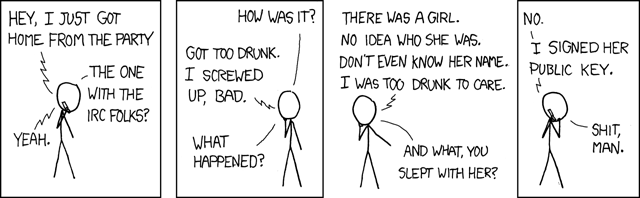
Do you agree? More interestingly, what do you think the answer will be in ten
years?
Posted on December 30, 2007 at 19:47
I am now a (very junior) notary in the thawte Web of Trust. An assurance from
me is worth 10 points towards the 50 required for a personal e-mail
certificate with your own name on it.
More details are available for those who are interested.
[Updated 20100118: Thawte recently closed down their Web of Trust and stopped issuing personal e-mail certificates. This article is now of only historical interest.]
Posted on September 3, 2007 at 13:48
As part of one of the more deeply nested yak shaving exercises I’ve been working through recently, I have added MicroIDs to various pages on this site. For example, the header for the main index page for this blog now includes the following elements:
<!-- MicroID for '/' variant of URL -->
<meta name="microid"
  content="mailto+http:sha1:b887e662ed3d811e665ef4a034e018a521a5467d" />
<!-- MicroID for '/index.html' variant of URL -->
<meta name="microid"
  content="mailto+http:sha1:ed938d07588303f4eeee45adfef090221e0c692e" />
A MicroID is a very simple way of making a verifiable statement about the ownership of a page. The specification goes into more detail, but essentially the value you see is constructed by independently hashing your e-mail address and the URL of the page in question, concatenating those results and then hashing once more.
The way you use a MicroID in practice is as supporting evidence for a claim of ownership to some third party who already knows your e-mail address. If you say “I own that page” to such a third party, they can compute the same MicroID value from your e-mail address and the page’s URL and then check for a match within the page’s <meta name="microid"> headers. You can see this claim checking by looking at the “verified” links in my claimID profile.
[2018-02-14: updated to remove the link to claimid.com, which has shut down.]
MicroID is an improvement on the perhaps more obvious approach of just embedding your e-mail address in the page because it doesn’t reveal your e-mail address to things like spam address harvesters. It also improves on a simple hash of the e-mail address by including the URL in the calculation because all pages owned by the same e-mail address are thereby given different MicroIDs. This in turn means that pages can’t be grouped together, even anonymously, by web spiders. Looked at from this point of view, a MicroID is a salted hash of the e-mail address.
I’m pretty sure that you could do the same job with one or even two less hash
operations (for example, the URL is known by definition, so hashing it serves no
purpose that I can see), but for static pages performance is not a concern. If
I was running a large content site with dynamically generated pages, though,
this aspect of MicroID might put me off a little.
Note that although a MicroID looks a little like a digital signature (of the URL) it really isn’t; in particular, a MicroID can easily be repudiated because anyone knowing your e-mail address can generate MicroID values “for” you and put them on any pages they please. In other words, you can use it to help confirm ownership of something by a claimant, but not to prove ownership by someone who denies the connection.
Generating the MicroID values for blog pages in particular was made simpler for me by Phil Windley’s MicroID plugin for Moveable Type. I did have to tweak it a little to correspond to the current MicroID spec, as Phil’s plugin as distributed generates what is now thought of as a “legacy” format lacking the scheme and algorithm specifiers.
Posted on August 21, 2007 at 14:15
I’ve previously mentioned my Networkshop 35 presentation in Exeter, and the fact that some of the material I prepared went unused because of lack of time.
As an experiment, I’ve narrated the unused slides and they are now available for
download in one of the following formats:
The presentation is a little under 20 minutes long. Please let me have feedback if you find this kind of thing useful, or for that matter if you find my voice too soporific or annoying. I’m considering doing more along these lines, and it would help to know in advance whether I’d be wasting my time.
Gearheads can read on for technical details…
Posted on May 8, 2007 at 14:15
I recently attended Networkshop 35 at the University of Exeter and presented a short talk on The UK Federation and Shibboleth: Nuts and Bolts. The idea was to discuss some of the technical challenges involved in the interplay between the UK Access Management Federation for Education and Research and the Shibboleth software, and talk about some future solutions to some of the issues.
As you can see from the integrated slide and video version of the talk available
from the conference site, I knew in advance that I’d be short of time so on the
day covered only the first two main topics: metadata and discovery.
[2018-03-02: Updated to remove links to the JISC archive of the Networkshop 35
site, which no longer exists and which was not captured by the otherwise
reliable Wayback Machine. The video of the talk appears to be lost to
the ages.]
I didn’t want to lose my thoughts on “trust” in the federation context, though, so instead of deleting the slides entirely I left them attached to the published version of the presentation. You can download the slides if you’re interested.
The University of Exeter, where Networkshop 35 was held, is fairly photogenic. I’ve uploaded a few snaps to give the idea.
Posted on March 28, 2007 at 10:02
We’re moving house at the end of next month. I’m told that the new neighbours
have been told that I’m “in computers” and that they are all looking forward to
meeting us. Hopefully this doesn’t mean they want me to fix their broken
Windows machines.
The good news is that if I need to explain what I actually do on the identity side of things, the JISC have just come to my rescue by producing a new animation explaining federated access management. The voice-over is pitched at a fairly non-technical level, and the little animated <Subject>s act out the scenes with a surprising amount of expression and a fair bit of wit. They remind me a lot of the little green guys in Darwinia, in fact.
This is not the sort of thing you’d use to communicate with a techie who wanted
to know the difference between Browser/POST and Browser/Artifact, but it’s a
pretty good introduction to some of the basic ideas for everyone else.
[Link]
[2018-02-15: relinked via the Wayback Machine]
Posted on November 30, 2006 at 18:10
In more UK Federation-related news, I’ve been invited to give a short
presentation next week as part of a panel session at the
Fall 2006 Internet2 Members Meeting in Chicago.
I’ve been asked to keep the impenetrable geekitude down to non-toxic
levels by sticking to a description of policy issues rather than implementation
and technology. You can get the other stuff from me pretty much any time.
Updated 2023-08-28: the original meeting site is gone, so I’ve updated the links
to use the Wayback Machine. The presentation itself is available from this site:
Posted on November 30, 2006 at 17:50
Today was the official launch of the UK Federation, or the UK Access Management Federation for Education and Research to give its Sunday name. This is a huge deal for everyone involved, myself included: some people have been working towards this point since around 2000 (I’m a relative newcomer, only having put a couple of years into it so far).
In the longer term, this will be a fairly important system for many more people:
after all, the UK Federation is a federated identity framework for the whole of
the UK education and research sectors, which I’m told involve perhaps
18 million people. If we do our job well over the next few years, though,
the best case is that like all good infrastructure it will just sink down below
the point where people even notice it. That’s a hard job, and we’ve only just
started on it.
Posted on November 13, 2006 at 12:47
I generated my first PGP RSA keypair way back in 1993. Some friends and I played around with PGP for e-mail for a while, but at the time few people knew about encryption and even fewer cared: the “no-one would want to read my mail” attitude meant that convincing people they should get their heads round all of this was a pretty hard sell. The fact that the software of the day was about as user-friendly as a cornered wolverine didn’t help either.
The PGP software had moved forward a fair bit both technically and in terms of usability (up to “cornered rat”) by 2002, when I generated my current DSS keypair. By this time, it was pretty common to see things like security advisories signed using PGP, but only the geekiest of the geeks bothered with e-mail encryption.
Here we are in 2006: I still use this technology primarily to check signatures on things like e-mailed security advisories (I use Thunderbird and Enigmail), but I’ve finally found a need to use my own key, and it isn’t for e-mail.
Over the years, PGP (now standardised as OpenPGP) has become the main way of signing open source packages so that downloaders have a cryptographic level of assurance that the package they download was built by someone they trust. Of course, the majority of people still don’t check these signatures but systems like RPM often do so on their behalf behind the scenes.
I’ve agreed to take on some limited package build responsibilities for such a project recently, so I’ve installed the latest versions of everything and updated my about page so that people can get copies of my public keys. Of course, there is no particular reason anyone should trust those keys; this is supposed to be where the web of trust is supposed to come in, by allowing someone to build a path to my keys through a chain of people they trust (directly or indirectly). Unfortunately, my current public key is completely unadorned by useful third-party signatures. If you think you can help change that (i.e., you already know me, already have an OpenPGP keypair and would be willing to talk about signing my public key) please let me know.
Posted on April 30, 2006 at 12:17
Phil Windley, Kaliya Hamlin and Doc Searls are running the Internet Identity Workshop 2006 this coming week. It sounds interesting, but Mountain View is a little out of my way.
On the other hand, who can do other than stand in awe in front of the Workshop logo, shown here? A dog, wearing a mask, sitting in front of a computer: perhaps the oldest gag in the digital identity game. I’d say “priceless”, but in fact you can buy merchandise.
[2019-05-02: Removed merchandise link, as the items are no longer available.]
Posted on November 29, 2005 at 15:10
Of course, the real reason I was in
Windermere was not to photograph ducks but to present some slides on the discovery problem in Shibboleth. You can download a copy of the presentation “WAYFs and Discovery” here (1.4MB PDF).
The abstract (accidentally omitted from the meeting material) was:
The standard model of Identity Provider discovery in Shibboleth deployments
is that of a federation-supplied, central discovery service called a WAYF.
Although an essential backstop, this approach has significant shortcomings.
We present some recent work in the area of multi-federation WAYFs, and review
alternative discovery technologies (both present and future) that allow
deployers to improve the user experience.
My co-author Rod Widdowson can be found here.
Posted on October 31, 2005 at 15:44
Every so often I vanity-google my own name, just to see what happens. I’m sure you do the same; who can resist?
I’ve been the number three “Ian Young” (according to Google) for a while. At number four is a chap at Intel who also shares a middle name with me, although as he apparently has 34 patents and invented the insides of lots of cool things he really by rights ought to be higher. He gets top billing for “Ian Alexander Young”, though.
Judging by the logs, some people find it easier to google for “Ian Young” than they do to remember the URL for this site. When looking at the server logs for the last month, though, I discovered that a fair number of people look for “iay” too. I’ve been using that identifier to log into things since about 1979 and sometimes have difficulty remembering my “human name”, but I didn’t realise this applied to other people too. Of course, they may have been looking for The Institute for the Study of Antisocial Behaviour in Youth, which comes above me in that search. No, the picture of the antisocial youth on their web site isn’t of me.
This is all rather strange but to me the most bizarre thing of all is that my Second Life avatar gets two of the only six hits for “Alexander Daguerre” (with the quotes this time). I suppose if I had thought about it, I could have looked for a combination Google had no record of and had the results page all to myself. How long before people start choosing names for their children that way?
Posted on October 13, 2005 at 19:05
Speaking of identity, Dick Hardt of Sxip gave a cracking keynote at this year’s Open Source Conference.
If you’re at all interested in digital identity (and you’re not allergic to Larry Lessig’s presentation style), I highly recommend spending taking the fifteen minutes required to watch this. It is very light on technical details, but gets across the critical differences between “old style” digital identity and the so-called “Identity 2.0” systems that are starting to emerge. It even manages to be entertaining while it does so. And the pictures of a Vancouver “Cold Beer and Wine” store bring back memories…
Posted on October 12, 2005 at 22:08
I’ve been scanning old entries from Kim Cameron’s Identity Weblog, catching up on things I missed the first time round. I’m only up to January so far, but there’s a lot of good thinking in there as well as links to some gems. One of the things I hadn’t seen before is an ACLU advertisement portraying a world in which the local pizza delivery company knows far more about you than they need to.
I find this to be quite a plausible and chilling picture of Identity Gone Wrong, although I’d probably worry more about those in authority having this kind of ability than about the pizza company. I’m sure there are people who would say that such things couldn’t happen, and that the ACLU are being needlessly alarmist. However, as you’re watching each of Kim’s Laws of Identity being broken, it’s quite easy to hear someone softly saying “we’re doing this for your convenience” or “we’re doing this for your security” in the background.
[2019-05-02: ACLU have a “10 Years Later” piece here.]
Posted on November 20, 2004 at 12:42
I was conned into doing a formal presentation for about 80 people the other day.
Normally, I’m quite happy with smaller team or client presentations to half a
dozen or a dozen people; the sudden scaleup put me in a mental state where (at
least to myself) I sounded like a crazed televangelist. Maybe it wasn’t that
bad in reality; some people even laughed a little at the
flying pig jokes and no
mouldy fruit was thrown.
The good news was that almost all of the technology worked perfectly. For
example, the normal experience of a tiny projector that sounds like a badly
maintained lawnmower was replaced by a huge bright fixed back-projection screen
that everyone could see clearly. No hunting around for books to prop the
projector up was required. No “where’s the remote, Bob?” conversations because
I brought my
own (I hate just standing behind the lectern). The exception was the sound
system: all the microphones seemed to be broken. I’m always a bit loud anyway,
so this wasn’t a problem.
If you’re curious, you can download a PDF copy of the presentation.
[2018-07-09: added a link to a PDF of the presentation. Added “identity”
tag.]


